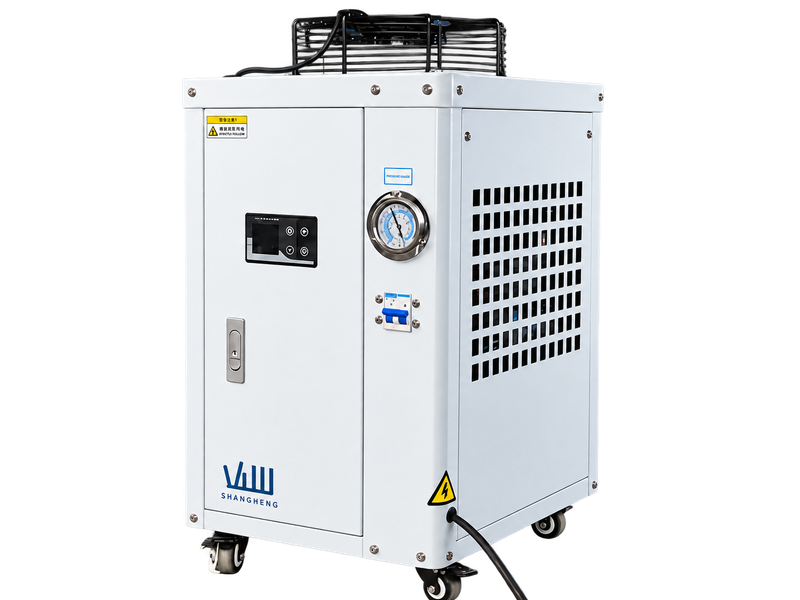
Start with the laser equipment’s cooling specification. Optical output power is not the heat load carried by its water circuit. Match the chiller configuration to the temperature, coolant quality and interface requirements of the specific laser model.
Obtain the exact equipment documentation
Provide laser-source and machine models, cooling-interface pages and installation manuals. Identify whether cooling serves the source, optical components or separate circuits.
- Request heat rejection, operating mode, temperature range and permitted variation.
- For two circuits, list individual temperatures and flows rather than only describing the system as dual-temperature.
Separate flow, pressure drop and pressure limits
Required flow, pressure loss at that flow and maximum allowable component pressure are different quantities. Include hoses, filters, fittings and equipment passages in the circuit review.
- Obtain connection sizes and pressure-drop data, then document hose length and layout.
- Confirm flow monitoring and shutdown signals rather than relying only on the pump nameplate.
Confirm coolant quality and condensation control
A laser manual may specify temperature, conductivity, particles and other water-quality limits. Follow the actual model’s requirements. Temperature settings must also account for ambient humidity and condensation.
- Ask the laser supplier to approve coolant, additives, wetted materials and maintenance intervals.
- Record maximum operating ambient conditions and agree on insulation and condensation-control provisions.
Confirm compatibility and joint acceptance
Compare the available chiller specifications against each laser requirement. Put any custom temperature-control duty in writing. Display resolution, temperature stability and measurement accuracy should be specified separately.
- Record load, supply and return temperatures, flow, pressure and alarm state.
- Agree on start-up, fault interlocks and recovery procedures with the machine supplier.
Common Questions
Is the laser’s output power enough to select a chiller?
No. Selection also requires heat rejection, temperature, flow, pressure, coolant quality and ambient conditions. Different lasers cannot be matched using optical power alone.
Can every laser use the same purified water or additives?
No universal assumption is appropriate. Follow the specific manual and check wetted-material compatibility. Do not add chemicals without approval for the equipment.