
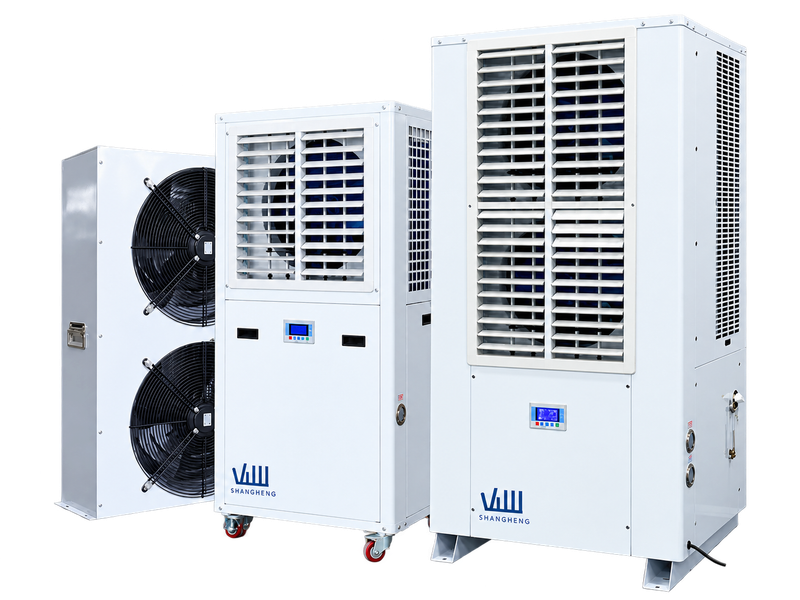
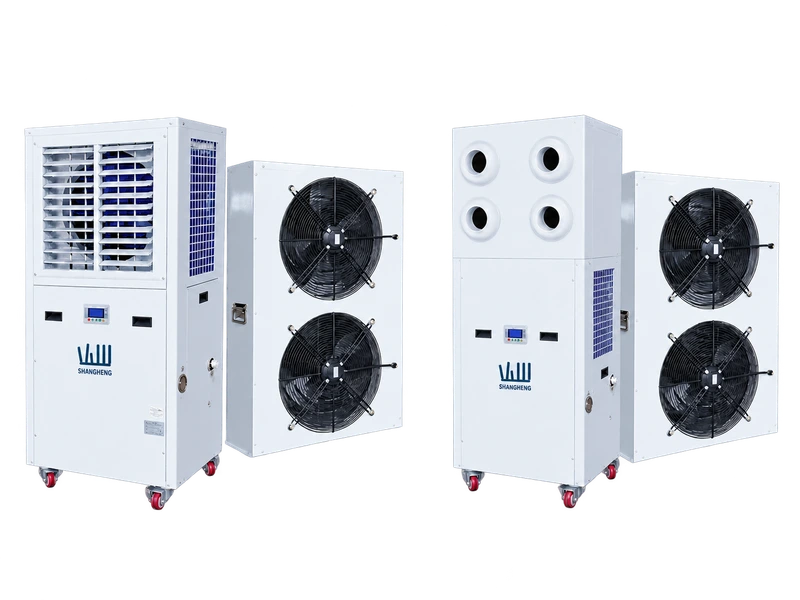
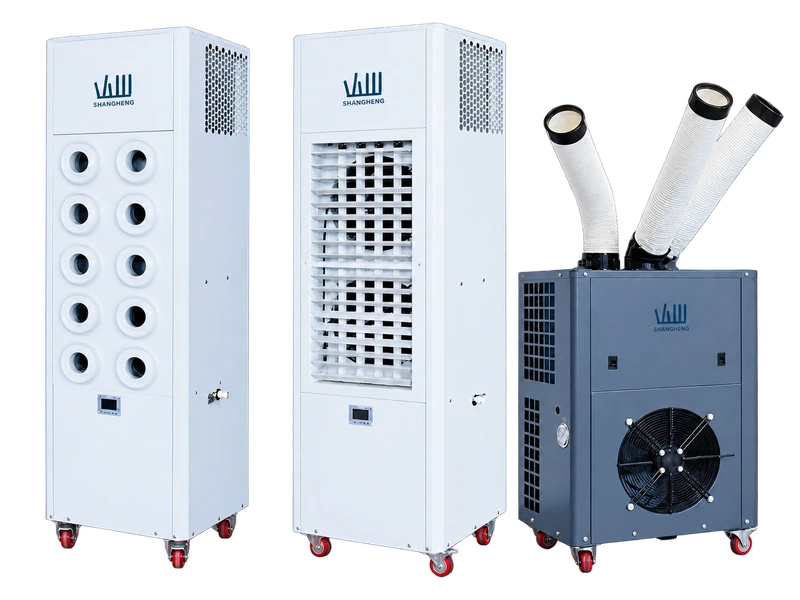
Shangheng Intelligent Technology manufactures and supplies industrial air conditioners for workshop air cooling, fixed workstations and portable spot cooling. Selection involves cooling capacity, air distribution, site utilities and quotation scope. Compare the three product families below, then prepare the application details and installation requirements for a manufacturer enquiry.
Compare industrial air conditioners for your workshop
HP identifies a product size; it is not the cooling capacity or electrical input. The ranges below apply to the listed families. Check the relevant specification table for each model’s cooling capacity, power input and electrical supply.
| Product family | Size range | Applications to assess | Key selection checks |
|---|---|---|---|
| Floor-standing louvered industrial air conditioner | 5–12 HP | Fixed air delivery towards benches, assembly stations and occupied work areas | Zone heat load, airflow direction, indoor and outdoor unit positions, power and drainage |
| Liquid-cooled air conditioner | 5–15 HP | Layouts requiring floor-standing, wall-mounted or ducted configurations | Model-specific heat rejection, circulating medium, water quality, interfaces and supporting equipment |
| Portable air conditioner | 2–5 HP | Changing workstations, temporary duties and spot cooling | Power, hot-air discharge, condensate handling and service access at every intended position |
- Whole-area control: select for the target zone’s heat load, enclosure and ventilation, with coordinated supply and return air.
- Fixed workstations: arrange louvered, jet or ducted airflow around occupied areas, obstructions and nearby heat sources.
- Moving workstations: confirm power, heat rejection and drainage at each position. Spot-cooling performance does not establish whole-workshop temperature control.
Determine cooling capacity and unit quantity
Floor area is a starting point. Height, the building envelope, equipment heat and incoming air also affect load. Define the target zone, temperature requirement and production mix during hot operating periods before selecting models and quantities. Check reference coverage and air-throw figures against the actual site.
- Building and ventilation: provide dimensions, clear height, roof and wall details, door-opening patterns, make-up airflow and extraction rates.
- Process heat: list normal and peak equipment heat, heating or drying processes, occupancy and simultaneous operation. Include heat rejected indoors by equipment such as air-cooled chillers.
- Cooling target: define whole-area or workstation duty, temperature and humidity requirements, shifts, permitted variation and downtime consequences.
- If information is incomplete, obtain equipment suppliers’ heat-release requirements and site temperature and humidity records before sizing. Do not treat total machine electrical power as the required cooling capacity.
What an industrial air-conditioner quotation should include
Request separate lines for equipment, accessories and site work, then compare equivalent configurations and responsibilities. The unit price is only part of the installed cost. A specific quotation requires agreed models, quantities and site provisions.
- Equipment: model, quantity, air-distribution format, electrical supply, controls and components included with the unit.
- Accessories and supporting equipment: ducts or airflow accessories, supports and drainage parts; list interfaces and supporting equipment for circulating-medium configurations.
- Transport and installation: identify whether packing, freight, unloading, handling, installation, wiring, piping and commissioning are included, and assign responsibility for each.
- Commercial and operating requirements: agree taxes, delivery timing, warranty terms, maintenance items and spare-parts arrangements. Estimate running costs using input power, load, operating hours and electricity rates.
Confirm airflow, heat rejection and site interfaces before installation
Mark people, equipment, heat sources and obstructions on a layout before arranging supply air, return paths and heat rejection. Check jet direction, duct resistance and the actual layout for distant workstations or multiple outlets. Follow the selected model’s installation and maintenance instructions.
- Air paths: avoid supply air returning directly to the intake and rejected heat re-entering the target cooling area. Plan process extraction and dust or gas control separately.
- Power and drainage: verify voltage, phase, frequency, circuit capacity, protection and condensate routes. For liquid-cooled configurations, confirm the medium, water quality, filtration and connection responsibilities.
- Handling and service: check dimensions, weight, delivery routes, supports, fixing arrangements and filter and heat-exchanger access.
- Maintenance: schedule filter, heat-exchanger and drain inspections for the dust, oil mist and operating hours, and keep cleaning and fault records.
Agree on acceptance conditions for workshop cooling
During selection, agree on production load, door conditions, measurement points, recording periods and acceptance criteria. Assess whole-area cooling by temperature distribution within the target zone; assess spot cooling at the specified workstations.
- Operating conditions: record indoor and outdoor temperature and humidity, running machines, production state and operating time.
- Cooling results: record multiple occupied-zone measurement positions, heights, temperatures and times, then compare them with the agreed targets.
- Installation and functions: check airflow, heat rejection, drainage, electrical supply and agreed controls; record and recheck corrective actions.
- Energy comparisons: use consistent workloads, operating periods and environmental conditions, with defined equipment boundaries and metering methods. Base the assessment on operating records.
Assess electrical-enclosure and process-cooling duties separately
Workshop air cooling, sealed electrical-enclosure temperature control and process-water cooling are different duties. Directing workshop airflow at a cabinet door does not establish internal component temperatures or enclosure protection. Machines requiring cooling water need a separate chiller-circuit assessment.
- For enclosures, provide dimensions, component heat losses, maximum ambient temperature, permitted internal temperature and ingress-protection requirements. Check dedicated cooling, mounting cut-outs and separation of internal and external air.
- For dusty, oily or humid environments, confirm air treatment, sealing and condensate provisions. Cold surfaces below the dew point may collect moisture.
Contact the manufacturer with these four enquiry details
Send the information already available to discuss selection with Shangheng Intelligent Technology. Phone / WhatsApp: +8618926068183. Email: yeli330549@gmail.com.
- Cooling objective: whole-area or workstation duty, target temperature and humidity requirements, and operating shifts.
- Site layout: a dimensioned plan or site photographs showing height, workstations, heat sources, doors, windows and available installation positions.
- Equipment and utilities: production machines and heat-release information, electrical supply, drainage, ventilation and existing circulating-water provisions.
- Purchasing requirements: estimated quantity, delivery timing and required transport, installation or accessories. Agree on models, equipment layout, supply responsibilities and acceptance conditions during the proposal stage.
Common Questions
Which industrial air conditioners does Shangheng supply?
The current range includes 5–12 HP floor-standing louvered industrial units, 5–15 HP liquid-cooled units and 2–5 HP portable units. Detailed model specifications are available for each family; airflow formats and site provisions depend on the selected model.
Why is HP alone insufficient when comparing manufacturer quotations?
The same HP designation does not establish identical cooling capacity, electrical input, configuration or supply scope. Compare specific models under equivalent operating conditions and confirm accessories, freight, installation, taxes and warranty terms.
Can capacity be selected using a fixed HP per square metre?
Area is only a starting point. Height, enclosure, process heat and ventilation vary substantially. Define the load and target area before selecting a model.
Does workstation cooling provide the same temperature across the workshop?
That cannot be assumed. Directed airflow serves specified workstations. Whole-area temperature control requires a separate assessment of total load, enclosure and air distribution.
Do all liquid-cooled models need the same external water circuit?
The name alone is insufficient. Check the selected model’s system diagram and supply list for heat rejection, circulating medium, connections and any external facilities.
Is connecting power enough to use a portable air conditioner?
Also check electrical compatibility, airflow, hot-air discharge and condensate handling, and provide the service clearances in the manual. Connections and operating conditions vary by model.
Can a workshop air conditioner serve directly as an enclosure cooling unit?
These duties are not equivalent. A sealed cabinet needs selection based on internal heat losses, ambient conditions, protection requirements and condensation risk. Workshop-unit ratings do not establish dedicated enclosure performance.